

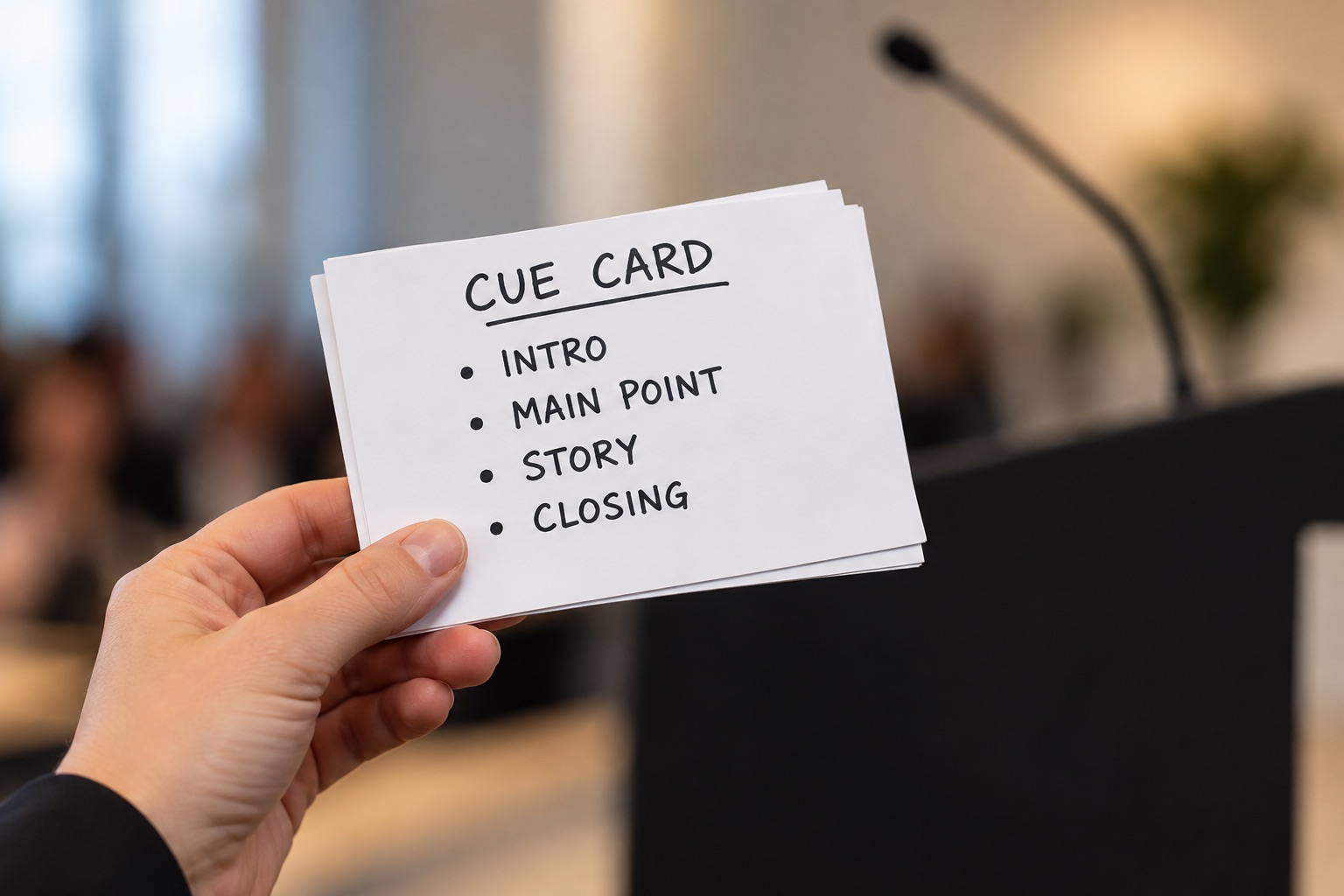
Short answer: cue cards are small cards holding keywords and short prompts — not full sentences — that a speaker glances at to stay on track. They keep your delivery natural because you are reminded of your next point, not reading it aloud. Standard sizes are 3×5, 4×6 and 5×8 inches, and one card should hold roughly 25 to 40 words in large print.
What are cue cards?
Cue cards are small, stiff cards a speaker holds or places out of shot, each carrying the cue for one section of what they are about to say. The word that matters is cue. A cue card is not a page of your speech shrunk down — it is a trigger. You look at three or four words, remember the point, and say it in your own words while looking at your audience or your lens.
That distinction is the whole reason they survived the arrival of teleprompters, tablets and earpieces. A script gives you the exact wording and takes your eyes with it. The cards give you the structure and leave the wording to you, which is why the delivery still sounds like a person talking.
Cue cards vs. notes vs. teleprompter
These three get mixed up constantly, and choosing the wrong one is the most common reason a delivery falls flat.
| Cue cards | Paper notes | Teleprompter | |
|---|---|---|---|
| What is written | Keywords and prompts | Paragraphs or bullet points | The full script, word for word |
| Where your eyes go | Quick glance, then back up | Down at the page, often for long stretches | Straight ahead, on the lens |
| How it sounds | Conversational, slightly different each take | Hesitant when you lose your place | Exact, and flat if you rush it |
| Best for | Talks, hosting, pieces to camera you know well | Meetings and internal briefings | Precise wording: legal, medical, sponsor reads |
| Weak point | Useless if you overfill them | Kills eye contact | Needs setup and rehearsal |
The cards sit in the middle: more structure than improvising, more freedom than a script. If the exact wording matters — a sponsor read, a medical claim, a legal disclaimer — skip the cards and use a free web teleprompter instead.
What are cue cards used for?
Speeches
The classic use. A best man, a keynote speaker or a student presenting coursework holds a small stack, one card per section. The cards carry the opening line, the three points, the transitions and the closing line. Everything between those markers is spoken, not read.
Presentations
When you are presenting slides, the card does the job the slide should not: it holds what you say. The slide carries the visual, the card carries your line. One card per slide, and a number in the corner so a dropped stack does not end your day.
Video and hosting
On television, cue cards were held next to the lens by a stagehand long before prompters existed, and late-night shows still use them. For solo creators the same idea works: cards taped just under the camera, at eye level, so your glance is short and your eyeline barely moves.
Live events and MCs
Hosts use cards for the parts that must be right: names, titles, sponsor mentions, the running order. Everything else is improvised. This is the one case where writing a full sentence on a card is correct — get someone’s name wrong and nothing else you say matters.
Communication cue cards
A different use of the same term. In speech therapy, special education and care settings, these cards carry a word, a picture or a symbol to help someone express a need or follow a routine. Same principle — a small card holding one clear prompt — applied to being understood rather than to performing.
What size should cue cards be?
Three standard index card sizes cover almost every situation:
- 3×5 in (76 × 127 mm) — fits in one hand and stays hidden. Best for a speech where you do not want the cards to be the story. Holds roughly 25 words in readable print.
- 4×6 in (102 × 152 mm) — the best default. Enough room for a heading and three prompts without shrinking your handwriting.
- 5×8 in (127 × 203 mm) — for cards held off camera by someone else, or read from a distance. Too big to hold discreetly.
The size is decided by reading distance, not by how much you want to write. If the card is in your hand, 3×5 or 4×6. If it is a metre away next to a lens, go to 5×8 and write bigger.
How many words fit on a cue card?
This is the question that decides whether your cards work, and almost nobody answers it. A practical guide:
- 3×5 card: about 20 to 25 words, four or five short lines
- 4×6 card: about 30 to 40 words
- 5×8 card: about 50 to 60 words, and you are close to writing a script
Those figures assume large print — roughly 24 point typed, or handwriting you can read at arm’s length without leaning in. Any smaller and the card stops working, because a card you have to squint at pulls your eyes down for two seconds instead of half a second, and the audience sees it.
Work backwards from your speaking time. Most people speak at 130 to 150 words per minute in conversation. A five-minute talk is therefore around 650 to 750 spoken words — but your cards should carry only the prompts, so eight to twelve cards is plenty. Run your draft through a words per minute calculator to find your real pace, or a script timer to see how long the finished talk runs.
How to write cue cards, step by step
1. Start from an outline, never a script
Write your talk as a list of points first. If you draft the full script and then try to cut it down to cards, you will end up with tiny handwriting and a card you read word for word. Start with the skeleton and the cards write themselves. A script template helps if you want the structure ready-made.
2. Turn sentences into triggers
Take each point and cut it to the two or three words that bring the whole thought back. “Our revenue grew forty per cent last year, mostly from returning customers” becomes “+40% — returning customers”. You know the rest. The card only has to remind you it is next.
3. One idea per card
Resist filling the space. A card with one idea is glanced at; a card with four is read. If a section needs more, split it across two cards rather than writing smaller. Number every card in the top corner — the moment you drop an unnumbered stack, the cards become the problem instead of the solution.
4. Make it readable at a glance
Print or write in capitals, dark ink on white or cream, one line of space between prompts. Write on one side only: turning a card over on camera is visible and turning it back is worse. Bold the first word of each line so your eye lands on it without searching.
5. Add delivery cues, not just content
This is the step most people skip and it is what separates a good card from a shopping list. In the margin, note what your body should do: PAUSE, SLOW, look at camera, hold for laugh. You are cueing a performance, not just recalling facts.
A reusable cue card template
Copy this onto a 4×6 card. Front carries what you say, back carries how you say it — and you only ever look at the front.
FRONT                                 [ 3 / 9 ]

SECTION: Why it matters

  • 40% of takes fail on line one
  • Rehearsal > memorising
  • Story: the wedding speech

NEXT → The three fixes
BACK (rehearsal only — never read on stage)

  PACE:   slow down on the statistic
  PAUSE:  two beats after "line one"
  EYES:   audience left, then camera
  TIME:   should be at 2:10 by the end
Three things make this template work: the card number in the corner, the NEXT line so you always know what is coming, and a section heading so you can find a card mid-talk without reading all of them.
Three cue card examples
Opening card, speech. The one card where writing the exact words is allowed — first lines are where nerves hit hardest.
[ 1 / 8 ]  OPEN

"I was asked to keep this under four minutes.
 I have failed already."

  PAUSE for laugh
  → Then: how I met Sam
Main point card, presentation. Keywords only. You know this material; the card just keeps the order straight.
[ 4 / 11 ]  RESULTS

  • Q3: +40%, returning customers
  • Churn down to 4%
  • Not the ad spend — the onboarding

NEXT → What we changed
Transition card, host or MC. Names and titles written out in full, because getting a name wrong undoes everything else.
[ 6 / 14 ]  HANDOVER

  Thank the panel — by name:
  Amara Osei / Lucas Brandt / Priya Raman

  "Next up, twenty minutes on..."
  → Dr Elena Marsh, Head of Research
How to use cue cards on camera
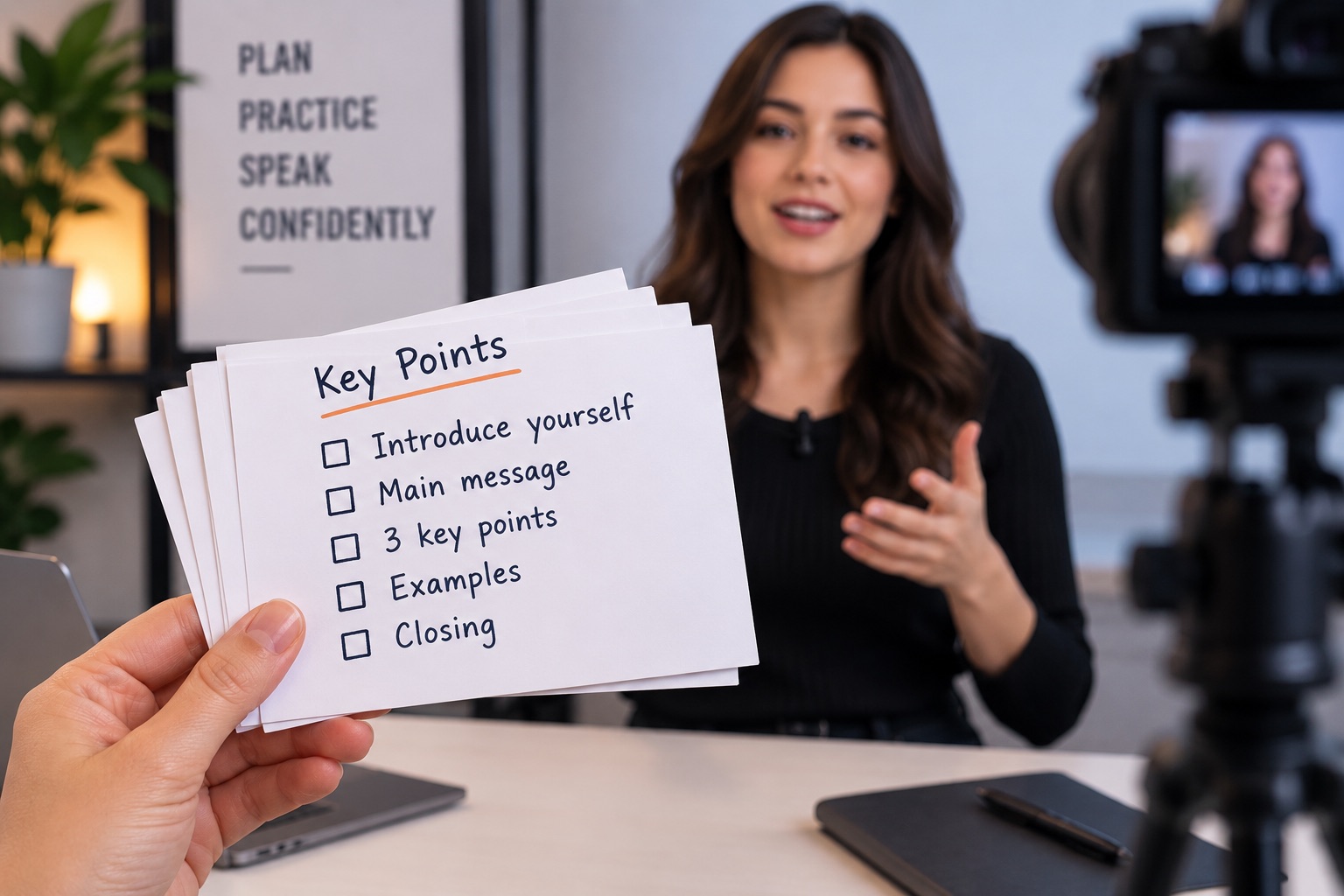
Filming yourself changes the rules, because the camera sees your eyes far more clearly than a room full of people does.
- Get the cards next to the lens, not below your chest. Tape them to a stand or a box just under the camera. The shorter the distance your eyes travel, the less the glance reads as looking away.
- Never hold them in frame. If the cards are visible, the viewer watches the cards.
- Glance between sentences, not during them. Finish a thought, look down, look up, start the next. Reading and speaking at the same time is what makes people sound like they are reading.
- Print instead of writing. Handwriting that is fine on a desk is unreadable at a metre away under a light.
- Record one section per take. With cards you have natural cut points already — use them instead of trying to nail eight minutes in one go.
If you find yourself taping five cards around the lens, that is the signal you have outgrown cards for this particular video.
Common cue card mistakes
- Writing full sentences. The single most common mistake. The moment a card holds a sentence you read it, and the delivery goes flat.
- Too many cards. Above fifteen you spend the talk managing paper. Merge sections.
- No numbers. Number them. Always.
- Writing on both sides. Turning cards is visible and interrupts you.
- Never rehearsing with them. They need one rehearsal to learn where things are on the card. Reading them for the first time in front of an audience defeats the point.
- Print that is too small. If you have to lean in, the card is too full.
When to switch from cue cards to a teleprompter
Cue cards stop being the right tool when the exact wording matters more than the naturalness. Switch when:
- the wording is fixed — sponsor reads, legal or medical copy, anything approved by someone else
- the piece runs longer than roughly five minutes to camera
- you need takes to match each other for editing
- you are filming alone and cannot hold cards and operate the camera at once
You do not have to buy hardware to try it. A free web teleprompter runs in a browser, and AploCam puts the script over the camera on an iPhone so you can write, rehearse, record and edit in one place. If you are comparing options, we have a rundown of teleprompter alternatives.
Plenty of experienced speakers use both: a prompter for the scripted open and close, cards for the conversational middle.
Frequently asked questions
What is a cue card for a presentation?
A small card holding the keywords for one slide or one section, so you can say your line while looking at the room rather than at the screen. One card per slide, numbered, keywords only.
How do you make cue cards?
Outline your talk, cut each point down to two or three trigger words, write one idea per card in large print on one side only, number them in the corner, then rehearse once with the stack in your hand.
What size cue cards should I use?
4×6 inches for most situations. Drop to 3×5 if you want the cards hidden in your hand, go up to 5×8 if someone is holding them next to the camera.
How many words should be on a cue card?
Around 25 words on a 3×5 card and 30 to 40 on a 4×6, in print you can read at arm’s length. If you need more, split the section across two cards rather than writing smaller.
What is the difference between cue cards and a teleprompter?
They hold prompts and you supply the wording, which keeps the delivery conversational. A teleprompter scrolls the full script and keeps your eyes on the lens, which is what you want when the exact words matter.
What are communication cue cards?
Cards carrying a single word, picture or symbol, used in speech therapy, special education and care settings to help someone express a need or follow a routine. Same idea as a speaker’s cue card, applied to being understood.